Georgia’s economy expands as political protests enter second year
Tourist visits reached a record high of 5.5 million in 2025, coinciding with two years of demonstrations against the ruling Georgian Dream party.
By Hector Medina ·
Tourist visits to Georgia reached a record high of 5.5 million in 2025. This figure represents an 8.4 percent increase over 2024 levels. It is nearly ten times the number of international visitors who came to the country two decades ago, which was approximately 560,000.
The surge in tourism occurs as the country marks two years of political unrest. The crisis began after the contested parliamentary elections on October 26, 2024. Protests started two days later and peaked on November 28. On that date, the government announced it would not place the opening of EU negotiations on its agenda before the end of 2028.
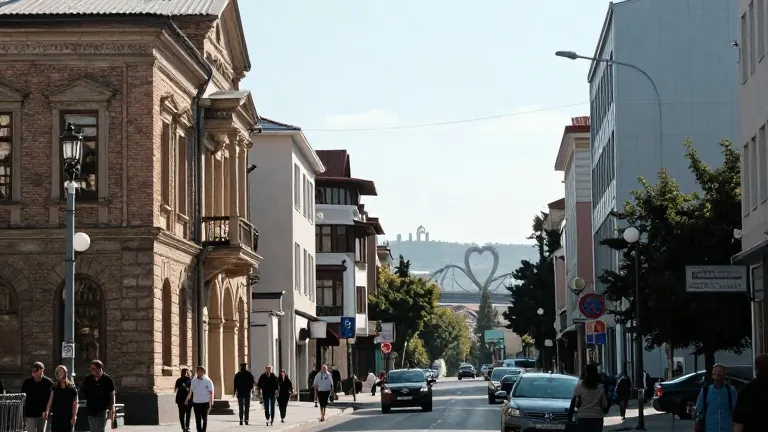
Every weekend, crowds gather in Avlabari Square in Tbilisi’s Armenian quarter. They march toward the Bridge of Love, reach Freedom Square, and proceed to parliament. Demonstrators chant slogans against Prime Minister Irakli Kobakhidze and his party, Georgian Dream. The party has held power since 2012 and is accused of authoritarianism by its critics.
Georgian Dream suspended EU accession talks, a move that opponents believe brings the country closer to Moscow. Georgia was granted EU candidate status in 2023. Many citizens desire closer ties to Europe and a more democratic system, yet the country continues to attract visitors drawn to its historic sites and post-Soviet atmosphere.
Russian visitors form a large portion of the international influx. Following Russia’s full-scale invasion of Ukraine in 2022, tens of thousands of Russian citizens relocated to Georgia. They brought money and opened businesses, but also exerted pressure on the property market by buying homes across the country.
This influx has fueled local discontent. Many Georgians still view Russia as an occupying power, citing the early 1990s wars in South Ossetia and Abkhazia and the brief August 2008 war. After the 2008 conflict, Russia consolidated military control over Abkhazia and South Ossetia. These regions account for approximately 20 percent of Georgian territory.
Despite severed diplomatic relations, Russia remains a major economic partner for Georgia. Trade, tourism, remittances, and energy imports from Moscow support the Georgian economy. The country’s GDP rose by 7.5 percent in 2025, marking five consecutive years of expansion.
The economy still faces challenges including unemployment, low wages, and widespread poverty. Rural areas continue to experience depopulation. Georgia is a republic roughly the size of Ireland with a population of fewer than 4 million. It emerged from the Soviet Union in 1991.
The country is located between Russia and Turkey, alongside Armenia and Azerbaijan. It offers mountain villages along the Georgian Military Road, ancient Orthodox churches, and wine with a millennia-old history. The port city of Batumi is often described as a lively Black Sea resort, while the capital, Tbilisi, features a rich underground scene and repurposed industrial spaces.
Bidzina Ivanishvili, who founded Georgian Dream in 2012, renovated the Rustaveli theatre 20 years ago. He served as prime minister between 2012 and 2013 and made his fortune in Russia during the 1990s. Relations between Tbilisi and Brussels have deteriorated recently, with the EU criticizing the government’s record on the rule of law.
Source: The Guardian